
The short answer
PLA was the best first-generation bioplastic the market could offer. It is useful in the right industrial composting system, but that system is expensive and fragile. PHA/PHB is different because biological degradation is a property of the material and can be validated across soil, marine, compost and anaerobic routes.
PP, PLA and PHA on one city bill
The buyer sees a cup. The city sees a collection route, sorting errors, contamination, compost cycles, landfill fallback and public communication. The real comparison is material price plus the system that has to exist after use.
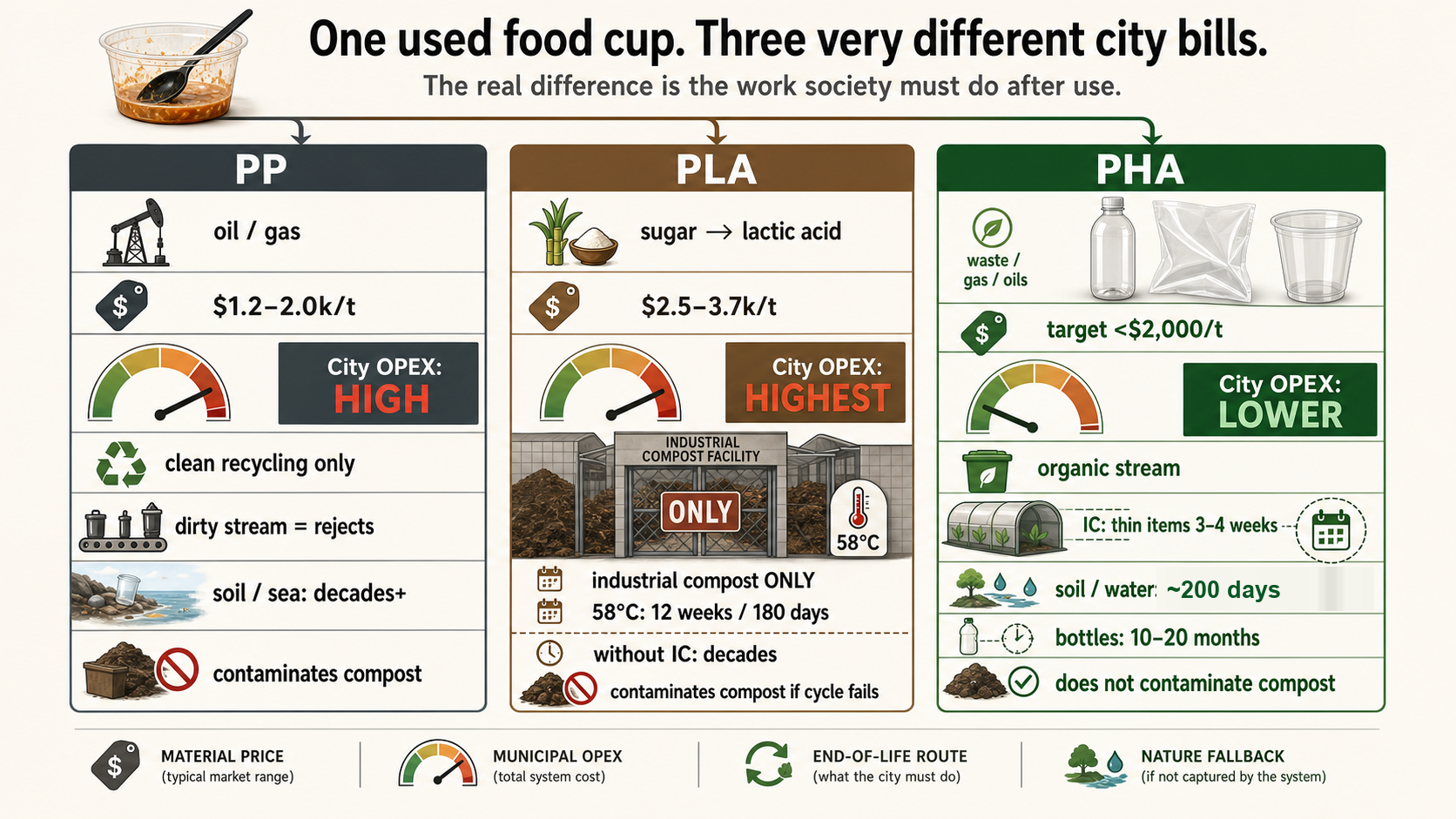
| Lens | PP | PLA | PHA |
|---|---|---|---|
| Material price | $1.2-2.0k/t resin before EPR, disposal fees and country plastic taxes | $2.5-3.7k/t | $3.7-4.1k/t today; not subject to plastic tax |
| Landfill fallback | Around 200 years | At least 20-50 years without industrial composting | Around 20 days in bioactive anaerobic conditions |
| Soil fallback | Decades and microplastic | At least 20-50 years | 220 days for thin formats |
| Marine fallback | Persists and fragments | At least 20-50 years | 60-100 days for thin straw-like formats |
| System cost | Sorting, washing, rejects, WTE, landfill and leakage | Separate bins, hot compost, contamination control | Organic route and shorter fallback if collection fails |
Why PLA needs infrastructure
- Temperature: PLA needs a hot industrial composting route, normally around 55-60 °C.
- Collection: PLA packaging has to be separated from conventional plastic and from the wrong organic stream.
- Cycle length: The operator needs enough time, heat and process control; a short food-waste cycle is not the same thing.
- Contamination: If PLA enters a conventional compost route incorrectly, the plant can reject the stream.
Why PHA behaves differently
- Biological carbon: PHA is a bacterial storage polymer, so microbial environments can use it as carbon.
- No PLA-style heat dependency: PHA can be validated in soil, water, compost and bioactive anaerobic routes without relying only on hot industrial composting.
- Geometry still matters: Film, straw, cup wall, bottle wall and coating do not degrade at the same speed.
- Claim discipline: Each SKU needs formulation, thickness and route validation before a public claim.
Landfill question
For a bioactive anaerobic landfill-like route, PHA can degrade around 20 days. This is a material degradation answer, not a claim about landfill gas collection equipment. Gas capture is a climate-management question; microbial degradation speed is a material-and-environment question.
Soil and marine fallback
PHA thin formats can be designed for roughly 220 days in living soil and 60-100 days in seawater for straw-like geometry. PLA without industrial composting should be treated as a long fallback case: at least 20-50 years.
Real system cost
PP resin at $1.2-2.0k/t is not the full public cost. It can carry EPR, disposal fees, sorting cost, landfill or WTE cost and country-specific plastic taxes. PLA adds a different bill: separate bins, education, logistics, hot composting and contamination control. PHA is more expensive per tonne today, but it is not subject to plastic tax and is meant to reduce the system debt.
What fails in real composting
- Wrong temperature: Many compost routes are not hot PLA routes.
- Wrong residence time: Food-waste systems can be too short for PLA.
- Wrong stream: Mixed packaging and food residue make operators reject material.
- Wrong communication: Users hear biodegradable and assume any bin works.
Geography of infrastructure
Industrial composting exists in selected places, not as a universal global default. A buyer shipping PLA cups into GCC hospitality, aviation or mixed municipal streams cannot assume the certification route exists locally.
China lesson
China built the largest PLA supply base, but the policy direction increasingly recognises PHA/PHB because end-of-life infrastructure is the hard part. Material substitution without infrastructure substitution can leave cities with a new sorting problem.
PBAT role
PBAT is useful as a flexible blend component, especially for bags and films, but it is not the same material story as PHA/PHB. In Circulera logic, PBAT may help product performance; PHA carries the stronger biological-material argument.
Organic route design
Food-contaminated single-use packaging should ideally follow food waste. PHA allows a simpler route: food residue, PHA packaging, compost or digester, then soil. If small fragments remain after a short cycle, PHA can continue biodegrading in living soil instead of forcing the plant to reject the stream.
Incineration and WTE
Waste-to-energy can reduce landfill volume, but it is not material circularity. For contaminated single-use packaging, the better industrial question is whether the material can reduce the need for sorting, washing and long-lived leakage before WTE becomes the fallback.
LCA and TCO
PLA requires a hot composting chain before it becomes a credible end-of-life solution. Many GCC use cases are food-contaminated, mixed-stream or hospitality-driven. PHA/PHB can be designed for a simpler organic-route logic and for local production economics.
Buyer decision matrix
- Clean recycling: PP can work only when the product is clean, sortable and locally accepted.
- Hot compost: PLA can work only when collection, heat, time and contamination are controlled.
- Food waste: PHA is stronger because it can be designed around an organic stream.
- Mixed municipal waste: PHA gives a better fallback than PLA, but the claim still needs route evidence.
- Marine leakage risk: PHA thin formats have a material argument; PP and PLA do not.
- Landfill: ask for bioactive anaerobic evidence, not slogans.
- Plastic tax country: PP price must be read after tax, EPR and disposal fees.
- Transparent packaging: use PHA/PBAT or PHA routes where clarity and food contact work.
- Fibre look: use bagasse or paper with PHA coating where barrier is needed.
- Low-cost commodity: do not pretend PHA beats PP resin today.
- Defensible claim: test SKU, route, thickness and formulation.
- Public explanation: avoid PLA unless the local compost route truly exists.
Supplier questions
- Material identity: is the product PHA/PHB, PLA, PBAT, bagasse, paper coating or a blend?
- Resin origin: who makes the resin and what is the current industrial price basis?
- Tax status: is the material subject to the buyer country plastic tax or exempt as biodegradable?
- Route evidence: industrial compost, soil, seawater, anaerobic, landfill-like or home compost?
- Geometry: was the tested item the same thickness and shape as the commercial SKU?
- Food contact: which regulation and country are covered?
- Contamination: what happens if the product carries food residue?
- Operator acceptance: will the local waste operator accept or reject the material?
- Claim wording: what can be said on pack, in procurement and in public reporting?
- Fallback: what happens when ideal collection fails?
Term sheet for materials
- PP: polypropylene, fossil resin, cheap before end-of-life costs and taxes.
- PLA: polylactic acid, usually sugar or starch route, needs industrial composting for credible fast degradation.
- PBAT: flexible fossil-based biodegradable polyester, useful in blends but not the same story as PHA.
- PHA: polyhydroxyalkanoate, bacterial storage polymer family.
- PHB: polyhydroxybutyrate, a PHA family member.
- P4HB: poly-4-hydroxybutyrate, PHA-family medical and high-value material route.
- SUP: single-use plastic.
- EPR: extended producer responsibility.
- IC: industrial composting.
- TCO: total cost of ownership, including material, operations, taxes, disposal and fallback.
GCC conclusion
The GCC buyer does not need another material that works only if Europe-style composting infrastructure appears first. The stronger regional route is PHA resin, selected PHA/PBAT formats, PHA coating, controlled buyer pilots and local production that can be explained to cities, regulators and procurement teams.